Cadillac Lease Buyout: Key Takeaways
- A lease buyout lets you purchase your Cadillac at a pre-set price. This is usually the residual value listed in your lease agreement
- Your total cost goes beyond the buyout price. Taxes, title fees, registration, and financing can all increase what you pay
- Interest rates play a major role in affordability. Comparing lenders can significantly change your monthly payment and total cost over time
- The best decision comes down to value. If your Cadillac’s market value is strong and the buyout price is competitive, keeping the vehicle may make more financial sense than starting over
Most Cadillac drivers don’t choose the brand just for transportation. They choose it because they like the quieter ride, the comfort, and the overall feel compared to mainstream options.
By the time the lease ends, the decision usually comes down to practicality: Is it smarter to keep the vehicle you already know, or start over with a new payment and another lease cycle?
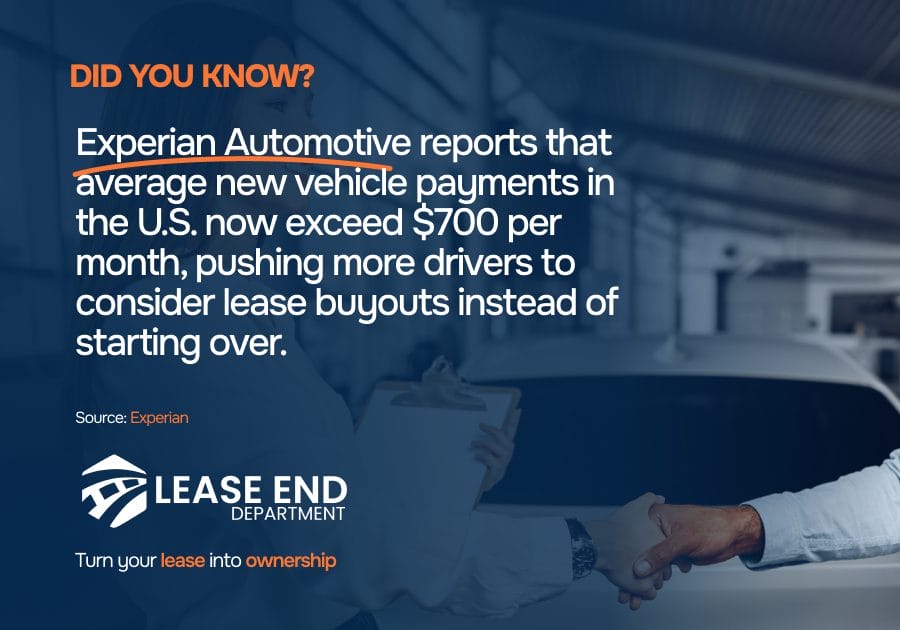
That decision matters more today than it used to, as the average new vehicle payment in the U.S. is now over $700 per month, pushing many drivers to reconsider starting over with a new lease or loan.
In some cases, the buyout price ends up looking more reasonable than replacing the vehicle.
In this guide, we’ll cover:
- How a Cadillac lease buyout works
- What fees, taxes, and costs to expect
- How to compare financing rates and options
- When buying your Cadillac makes financial sense
- Mistakes to avoid before finalizing your buyout
What Happens at the End of a Cadillac Lease
As your Cadillac lease comes to an end, you’re not locked into one outcome. You have a few clear paths forward. Each comes with different costs and long-term implications.
Your Three Lease-End Options
At lease-end, most drivers choose from three options:
- Return the vehicle: Hand the car back to the leasing company and pay any applicable fees, such as disposition, mileage, or wear-and-tear charges
- Start a new Cadillac lease: Move into a newer model, often with updated features and possible loyalty incentives
- Buy out your current lease: Purchase the vehicle at the pre-set residual value and transition into ownership
Some drivers want another new vehicle every few years, while others would rather avoid restarting the payment cycle if the current Cadillac still fits their needs.
Why Many Cadillac Drivers Consider Buyouts
For Cadillac drivers in particular, lease buyouts often become an appealing option.
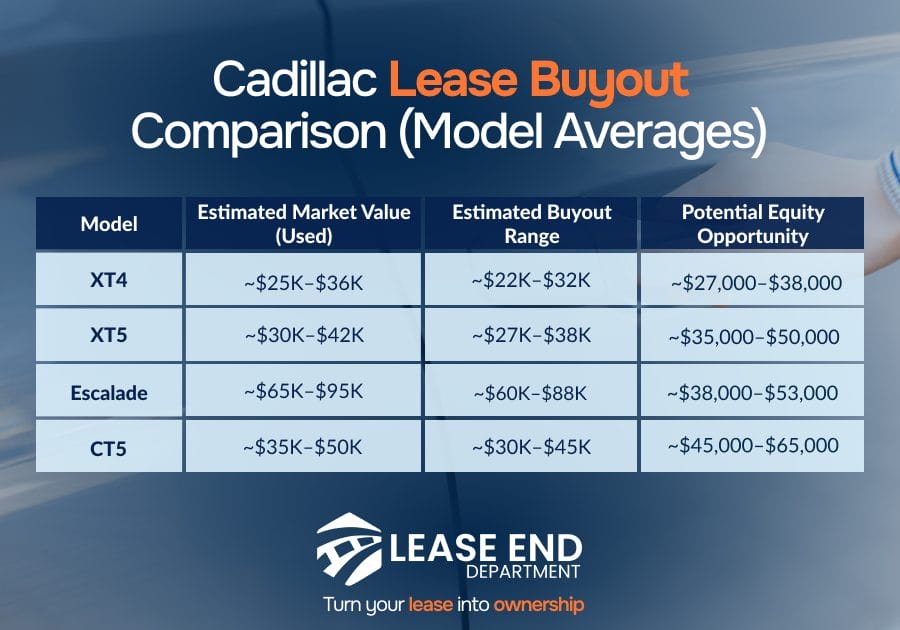
Cadillac SUVs like the Escalade and well-equipped XT5 or XT6 trims can sometimes retain stronger resale value than drivers expect, especially when mileage is low and inventory is tighter locally.
There are also practical reasons behind the decision:
- You already know the vehicle’s history, condition, and performance
- Luxury SUVs and sedans can retain strong resale value in certain market conditions
- Replacing a similar Cadillac with a new lease may come with significantly higher monthly payments
How the Cadillac Lease Buyout Process Works
The Cadillac lease buyout process is straightforward on paper, but the details can make a meaningful difference in what you pay. Knowing what to expect at each step helps you stay in control of the decision.
Step 1: Request Your Payoff Quote
Start by contacting GM Financial, which handles most Cadillac leases, and request your official payoff amount.
This quote typically includes:
- The residual value (set at the start of your lease)
- Any remaining payments if you’re buying out early
- A purchase option fee and possible taxes
One important detail: Payoff quotes are usually time-sensitive, often valid for just seven to 15 days. If you’re comparing options, timing matters.
Step 2: Compare to Market Value
Next, determine what your Cadillac is currently worth on the open market.
You can check:
- Kelley Blue Book
- Edmunds
- Dealer or instant-buy offers
Luxury vehicles like Cadillac SUVs can vary more in value depending on condition, mileage, and trim. That means your equity position can shift more than expected, especially in changing market conditions.
Many drivers are surprised by this step. According to Edmunds, vehicle values in the used market can differ significantly from residual values set years earlier, which is why checking current pricing is critical before making a lease-end decision.
It’s not uncommon for drivers to assume they should return the car, only to realize the buyout price is actually competitive, or even below market value.
Step 3: Choose the Right Buyout Timing
You can complete a buyout at two different points, and the timing affects your total cost.
- End-of-lease buyout: The simplest option, with no remaining payments and fewer variables
- Early buyout: Allows you to purchase the vehicle before the lease ends, but may include remaining payments and fees
Early buyouts are sometimes used to avoid mileage penalties or lock in value, but they require closer cost comparison.
Step 4: Complete Financing and Ownership
Once you decide to move forward, the final step is turning the lease into ownership.
You can:
- Pay cash for the buyout, or
- Use a lease buyout loan through a bank, credit union, or lender
From there, the process includes:
- Title transfer into your name
- Registration and taxes based on your state
- Finalizing paperwork with the lender or service provider
Comparing Financing Rates and Options
Financing plays a major role in the total cost of your Cadillac lease buyout. Even a small difference in interest rate can change your monthly payment and the total amount you pay over time.
Cadillac Financial vs. Outside Lenders
When financing a lease buyout, you typically have two main options.
Cadillac Financial (GM Financial) offers convenience. The process is streamlined, and everything can often be handled in one place. However, rates may not always be the most competitive.
Banks, credit unions, and online lenders tend to offer more rate competition. Credit unions in particular often provide some of the lowest auto loan rates, depending on your credit profile.
What Impacts Your Interest Rate
Two drivers buying out the exact same Cadillac can end up with very different loan costs depending on credit score, lender, and loan length.
- Credit score: Higher scores generally qualify for lower rates
- Loan term: Shorter terms (36–48 months) usually have lower interest rates than longer ones (60–72 months)
- Market conditions: Auto loan rates fluctuate based on broader interest rate trends
Average used car loan rates often range roughly between 6% and 10%, depending heavily on credit tier.
Example Loan Scenario
Here’s a realistic example based on current rate conditions:
- Loan amount: $30,000
- Term: 60 months
- APR: 6.5%
Estimated monthly payment: ≈ $587
That payment can move noticeably higher if rates increase or if the loan stretches into a 72-month term, which is becoming more common with higher vehicle prices.
Why Pre-Approval Matters
Getting pre-approved before visiting a dealership gives you a clear advantage.
- You know your true rate and budget upfront
- You can compare dealer financing against your pre-approved offer
- You reduce the risk of accepting a marked-up interest rate
When a Cadillac Lease Buyout Makes Sense, and What to Watch Out For
Deciding whether to buy out your Cadillac lease comes down to value, condition, and long-term cost. In some cases, it’s a smart financial move. In others, it may create unnecessary expense.
When Buying Your Leased Cadillac Makes Sense
A Cadillac lease buyout is often worth considering when the numbers and the vehicle condition align.
- Your buyout price is below current market value, creating potential equity
- You’ve kept mileage low, preserving the car’s value
- The vehicle is in excellent condition, with no major wear or damage
- You want to avoid higher payments associated with newer vehicles
A lot of lease-end drivers already know emotionally whether they want to keep the car. The financial side usually determines whether that decision is realistic.
Pros and Cons to Consider
Like any financial decision, a lease buyout has trade-offs.
Pros
- You keep a vehicle you’re already familiar with
- You avoid lease-end penalties like mileage or wear charges
- You may benefit from equity if the vehicle is worth more than the payoff
Cons
- Luxury maintenance costs can increase over time
- The factory warranty may expire, leading to higher repair risk
- Interest costs apply if you finance the buyout
Common Mistakes to Avoid
Most lease buyout regrets come from rushing the numbers or focusing only on the monthly payment instead of the long-term ownership cost.
One of the biggest mistakes is not comparing the payoff to the current market value, which can lead to overpaying for the vehicle. Another is focusing only on the monthly payment instead of the total cost, especially when financing is involved.
It’s also common to accept dealership financing without comparing other options, which can result in a higher interest rate than necessary.
- Always compare multiple financing offers before committing
Make the Smart Move With Lease End Department
Lease-end decisions are easier when you can clearly compare the cost of keeping the vehicle against replacing it.
It’s a decision point that can impact your finances for years.
A lease buyout can be a strong option, especially if your vehicle holds value, your payoff is competitive, and financing works in your favor. But the difference between a good decision and an expensive one often comes down to understanding the full picture.
That includes your payoff, taxes, fees, and most importantly, your financing rate.
That’s where Lease End Department comes in.
Instead of navigating the process alone or relying on dealership guidance, you can take a more informed approach and compare your options clearly before committing.
Why drivers choose Lease End Department:
- See the full cost upfront: Payoff, taxes, and fees clearly broken down
- Compare financing options: Find competitive rates that fit your budget
- Evaluate buyout vs next steps: Understand what actually makes sense
- Avoid dealership markups: Make decisions on your terms
- Simplify the process: From payoff to title and registration
Besides Cadillac, we also specialize in lease buyouts for additional popular brands, including:
Cadillac Lease Buyout: FAQs
Have questions about your Cadillac lease buyout? Here are the answers that matter most.
Can you buy out a Cadillac lease early?
Yes, you can buy out a Cadillac lease early, but your payoff may include remaining payments and additional fees.
How is a Cadillac lease buyout price calculated?
The buyout price typically includes the residual value, any remaining payments (if early), and a purchase option fee set in your lease agreement.
Do you pay taxes on a Cadillac lease buyout?
In most states, yes. A lease buyout is treated as a purchase, so sales or use tax is usually applied to the payoff amount.
Can you finance a Cadillac lease buyout?
Yes, you can finance a lease buyout through GM Financial, banks, credit unions, or online lenders.
What interest rate can you expect on a lease buyout loan?
Rates vary by credit, but recent data shows used auto loan rates typically range from about 6% to 10% for many borrowers.
Is it worth buying out a Cadillac lease?
It can be worth it if the buyout price is competitive, the vehicle is in good condition, and financing terms are reasonable.
Can you negotiate a Cadillac lease buyout price?
In most cases, no. The residual value is set in your lease contract, though fees and financing terms may vary.
What fees are involved in a Cadillac lease buyout?
Common fees include sales tax, title and registration fees, and a purchase option fee, along with possible financing costs.