Lease Mileage Limits: Key Takeaways
- Lease mileage limits directly impact your lease-end costs. Going over your limit can result in fees of 15 to 30 cents per mile, which can add up quickly
- High mileage reduces your vehicle’s value, but not your buyout price. The residual value stays fixed, which can make a lease buyout more appealing in some cases
- A lease buyout can help you avoid mileage penalties entirely. Instead of paying overage fees and walking away, you can apply that cost toward ownership
- The best decision comes down to comparing the numbers. Evaluating your penalties, payoff quote, and market value side by side helps determine whether returning or buying is the smarter move
Lease mileage limits are one of the most overlooked parts of a car lease, until the final months arrive.
At that point, every extra mile starts to matter.
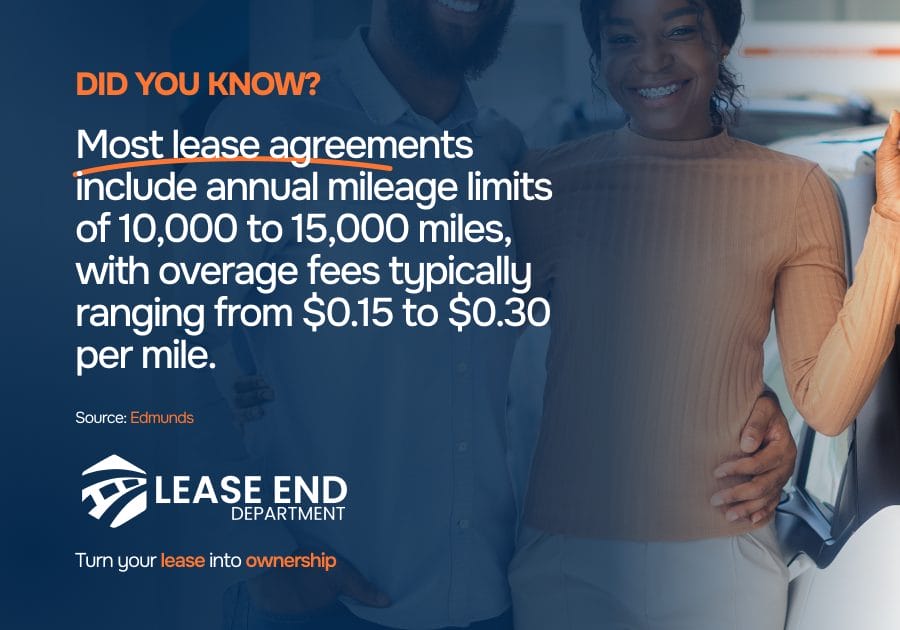
Most leases include limits like 10,000, 12,000, or 15,000 miles per year, and going over can trigger fees that add up quickly. In some cases, drivers are surprised to find they owe thousands of dollars just to return the vehicle.
But there’s another option.
Instead of paying lease mileage limits & penalties, some drivers choose to buy out their lease instead, especially when the numbers make more sense.
In this guide, we’ll cover:
- What lease mileage limits are and how they work
- How excess mileage affects your vehicle’s value
- The real cost of mileage penalties vs. a lease buyout
- When buying your leased car makes financial sense
- How to evaluate your decision before lease-end
What Are Lease Mileage Limits and Why Do They Exist?
Lease mileage limits are one of the main things baked into every lease, even if most people don’t think about them upfront. They define how many miles you’re allowed to drive each year without incurring additional charges.
Most leases come with annual limits such as:
- 10,000 miles per year
- 12,000 miles per year
- 15,000 miles per year
Over a typical three-year lease, that equals to a total allowance of 30,000 to 45,000 miles.
Why Mileage Limits Exist
Lease mileage limits aren’t arbitrary. They’re designed to protect the leasing company from unexpected depreciation.
The more miles a vehicle has, the lower its resale value tends to be.
Since leasing companies plan to resell the vehicle after the lease ends, they use lease mileage limits to:
- Control the vehicle’s future value
- Predict depreciation more accurately
- Reduce financial risk when the car is returned
How Lease Mileage Limit Affects Your Lease
When you sign a lease, the expected mileage is already built into your monthly payment.
- Lower mileage limits usually mean lower monthly payments
- Higher mileage limits typically result in higher payments, since the car is expected to lose more value
If you exceed your mileage limit, the leasing company charges a per-mile fee to make up for that added depreciation.
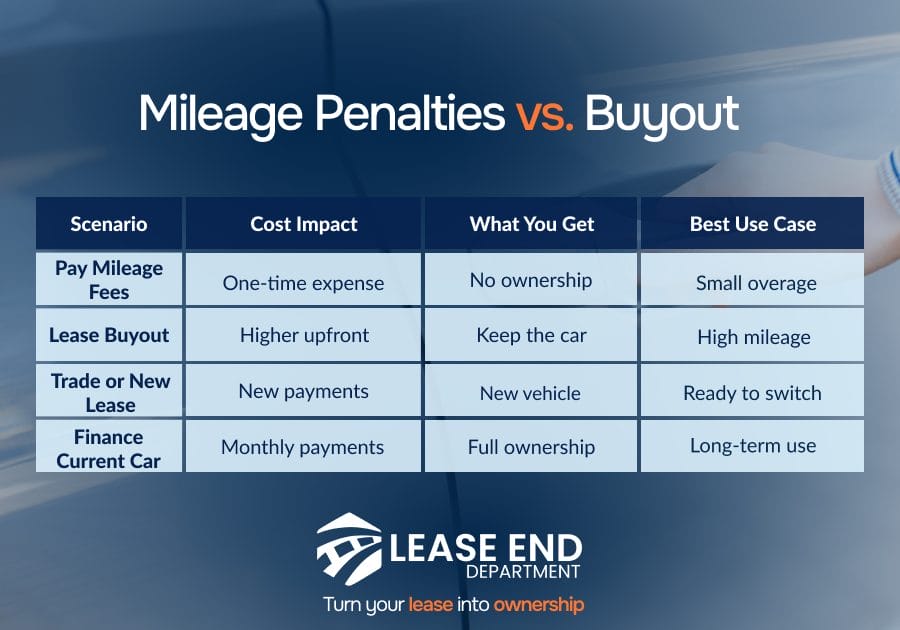
Mileage Penalties vs. Lease Buyout: Which Costs More?
If you’ve gone over your lease mileage limit, the key question becomes simple.
Should you pay the penalties and return the car, or buy it instead?
It really comes down to how the numbers stack up in your specific situation.
Option 1: Paying Mileage Penalties
When you return a leased vehicle over the mileage limit, you’ll be charged a per-mile fee, usually between 15 cents and 30 cents per mile.
These costs can add up quickly.
Example:
- 6,000 miles over limit
- $0.25 per mile
- Total penalty: $1,500
This is a one-time cost, but it doesn’t give you any ownership or long-term value.
Option 2: Buying Out the Lease
A lease buyout lets you avoid mileage penalties, but that doesn’t automatically mean it’s the cheaper move.
Instead of paying penalties, you:
- Pay the residual value (plus taxes and fees)
- Keep the vehicle regardless of mileage
This tends to matter more if you’re already well over your mileage limit.
The Real Cost Comparison
Here’s where the decision becomes more strategic.
- Mileage penalties are basically money you pay and never see again; you don’t get anything back in return
- A lease buyout converts that cost into ownership
If your penalty is high, that money might be better applied toward owning the vehicle instead of returning it when you reached the lease mileage limits.
When a Buyout May Cost Less
A lease buyout may be the better financial move if:
- Your mileage penalties are $1,000+
- The vehicle is still in good condition
- The buyout price is reasonable compared to market value
In these cases, buying the car can help you avoid fees and keep a vehicle you already know.
The Mileage “Break-Even Point” for Lease Buyouts
At a certain point, paying mileage penalties stops making financial sense. That’s where the break-even point comes in, the moment when buying out your lease may cost the same or less than returning the car with overage fees.
Understanding this point can help you make a more confident decision.
How to Think About the Break-Even Point
The idea sounds simple, but it’s where a lot of people second-guess their decision. You’re comparing what you’ll lose in mileage penalties with what you gain by keeping the car.
Mileage penalties are a one-time expense with no long-term benefit. A lease buyout, on the other hand, turns that cost into ownership. Once those numbers start getting close to each other, the decision usually shifts.
A Real-World Example
- 7,000 miles over limit
- $0.25 per mile
- Total penalty: $1,750
At this level, the cost is no longer minor. Many drivers begin to question whether paying that amount just to return the vehicle makes sense.
Where the Break-Even Point Usually Happens
There isn’t a fixed number, but most drivers start reconsidering when:
- Mileage penalties exceed $1,000–$2,000
- The vehicle is still in good condition
- The buyout price is close to market value
At this stage, the financial gap between returning and buying begins to narrow.
A Simple Way to Evaluate Your Situation
First, figure out roughly what your mileage penalties would look like, then compare that number to your lease payoff and your car’s current market value.
If the difference between returning and buying is small, the buyout often becomes the more practical option. You’re not just avoiding a fee, you’re turning that cost into something you keep.
How to Evaluate Your Lease Buyout Decision Step by Step
If you’re approaching lease-end with high mileage, the best move is to compare the numbers before making a decision.
A few simple steps in your thought process can quickly show whether returning the car or buying it out makes more sense.
Step 1: Check How Far Over the Mileage Limit You Are
Start by reviewing your lease agreement and current odometer reading. This tells you how many extra miles you may be paying for at turn-in.
Step 2: Calculate Your Estimated Mileage Penalties
Multiply your excess miles by your lease’s per-mile overage fee. This gives you a clearer picture of what returning the vehicle could cost.
Step 3: Request Your Lease Payoff Quote
Then check with your leasing company to get your exact payoff amount. This is the total cost to buy the vehicle, including any applicable fees or taxes.
Step 4: Compare the Car’s Market Value
Check what your vehicle is currently worth using tools like Kelley Blue Book, Edmunds, or dealer offers. This helps you see whether the buyout price is competitive.
Step 5: Compare Both Paths Side by Side
Once you have the numbers, compare the cost of returning the car with mileage penalties against the cost of buying or financing it. If the difference is small, a lease buyout may offer more long-term value.
How Lease End Department Helps You Make the Right Call
When lease mileage limits become a factor at lease-end, the decision isn’t always straightforward. Between overage fees, payoff quotes, and vehicle value, it can be difficult to know which option actually saves you money.
That’s where Lease End Department helps simplify the process.
Instead of guessing or relying on dealership guidance, you can compare your lease buyout options clearly and make a decision based on real numbers.
Why drivers turn to Lease End Department:
- Side-by-side comparisons: Understand the cost of returning your vehicle versus buying it
- Competitive financing options: Explore loan offers that fit your budget
- No dealership pressure: Make decisions on your terms, not in a showroom
- Full paperwork support: Title transfer, registration, and documentation handled for you
- Simple remote process: Complete most steps online or over the phone
When those mileage costs start creeping up, it helps to have someone walk through the numbers with you.
Lease Mileage Limits: FAQs
What happens if you go over your lease mileage limit?
If you exceed your lease mileage limit, you’ll be charged a per-mile fee at lease-end, typically between 15 cents and 30 cents per mile.
How much do lease mileage penalties cost?
Lease mileage penalties usually range from 15-30 cents per mile. The total cost depends on how many miles you exceed your allowed limit.
Can you avoid mileage penalties with a lease buyout?
Yes. If you choose a lease buyout, you won’t pay mileage penalties because you’re purchasing the vehicle instead of returning it.
How many miles can you put on a leased car?
Most leases allow 10,000 to 15,000 miles per year, though higher mileage limits may be available with higher monthly payments.
Is it better to buy or return a high-mileage lease?
It depends on the numbers. If mileage penalties are high and the buyout price is reasonable, buying the car may offer better long-term value.
Do lease mileage limits affect lease buyout price?
Lease mileage limits do not change the residual value in your contract, but high mileage can reduce the vehicle’s market value, which impacts your decision.
Can Lease End Department help with lease buyout decisions?
Yes. Lease End Department helps you compare lease mileage limits, penalties vs. buyout costs, secure financing, and handle the paperwork so you can make the most informed decision.