
Early Lease Buyout: Key Takeaways
- There’s no universal right answer. Buying out early and waiting until lease-end are calculated differently, and the better option depends on your specific numbers, not a general rule
- Buying out early often includes remaining payments on top of the residual value, which can change the math more than expected
- If your car’s market value has risen above your payoff amount, or you’re closing in on your mileage limit, buying out early tends to make more sense
- Waiting usually wins when your lease is almost done anyway. If there’s little time left, an early buyout may cost more in fees than it saves
Ever caught yourself standing in your driveway, coffee in hand, quietly doing math about your own car?
What’s this worth right now… what would I owe if I bought it out today… was that “great lease deal” my neighbor keeps bringing up even still true?
If so, congratulations, you’ve stumbled into one of the more specific little rituals of adulthood: the early lease buyout question.
Nearly 3 million vehicles were leased in 2024 alone, which means millions of drivers are either asking this exact question right now or will be soon.
The tricky part is that “buy it out early” and “wait until the lease ends” aren’t just two timing options. They’re calculated differently, cost differently, and make sense in genuinely different situations.
Today, we’ll walk through exactly how each path works, when buying out early tends to make sense, when waiting is usually the smarter move, and how to run the real math for your situation instead of guessing.
Should You Buy Out Your Lease Early or Wait
Short answer: it depends, and not in the annoying, dodge-the-question way that usually sounds.
What’s Driving the Question?
This question rarely comes out of nowhere. Something specific usually triggers it, and knowing what’s behind it helps you figure out which factors matter most in your situation.
A few of the most common triggers, grounded in how leases work:
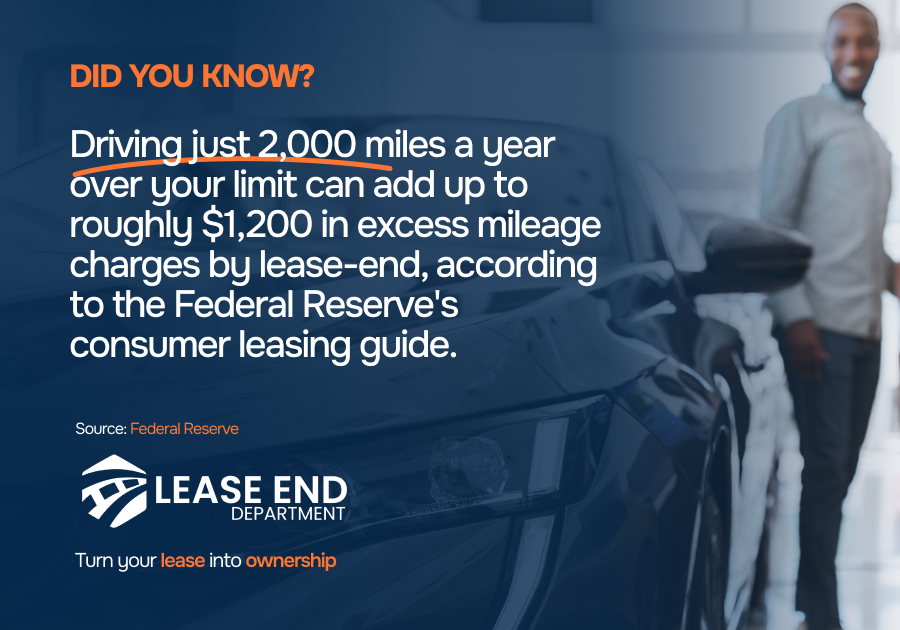
- Mileage. Most leases allow somewhere between 10,000 and 12,000 miles per year, and overage fees typically run $0.15 to $0.30 per mile once you exceed it. If you’re tracking toward, or past, that limit, the math starts shifting well before your lease officially ends
- Equity. The gap between your payoff amount and your car’s actual market value isn’t fixed, it moves with the broader used-vehicle market. Wholesale used-vehicle values climbed through the spring of 2026 before leveling off in August, which is a reminder that the “is my car worth more than I owe” answer can change over the course of your lease, not just at the end of it
- A change in plans. A move, a new job with a different commute, a growing family, anything that changes what you need from a vehicle can make waiting out the remaining term feel pointless
- Financing timing. Some drivers want to lock in a rate or loan term now rather than wait and risk financing conditions shifting before their lease is up
None of these alone determines the right answer. They’re just the reasons the question shows up in the first place.
There’s No Universal Right Answer, Only a Right Answer for You
Once you know what’s driving the question, the next step is understanding that “early” and “end of lease” aren’t just two dates on a calendar; they’re two different calculations, with different costs attached to each.
A driver with positive equity and 8 months left on their lease is in a completely different position than a driver who’s 3,000 miles over their allowance with a year to go.
That’s the framework this guide follows: rather than pushing one answer, we’ll walk through exactly how each payoff is calculated, then come back to when each option tends to make more sense, So, you can weigh it against your own numbers instead of someone else’s situation.
Early Lease Buyout vs. End of Lease: Costs and Factors to Compare
Everything covered so far comes down to one practical exercise: lining up the real numbers side by side. Here’s how the two options compare, and a worked example showing how close, or how far apart, they can land.
| Factor | Early buyout | End-of-lease buyout |
|---|---|---|
| Payoff formula | Residual value + most remaining finance charges, sometimes plus a fee | Residual value only, plus a purchase option fee if applicable |
| Remaining payments | Rolled into one lump sum now | None, already paid off month to month |
| Early termination/disposition fee | May apply, though often waived when you’re buying rather than returning | Not applicable |
| Sales tax | Varies by state; some tax the full remaining payment stream | Typically taxed on the buyout price only |
| Mileage exposure | Locked in as of today, no further overage risk | Continues accumulating until lease-end |
| Equity certainty | Based on today’s market value, which you know | Based on market value months from now, which you don’t |
| Financing timeline | Can lock in today’s rate | Rate depends on market conditions whenever the lease ends |
A Worked Example
Say you’re 10 months from lease-end on a vehicle with a $24,000 residual value and $420 monthly payments.
| Early buyout (now) | End-of-lease buyout (in 10 months) | |
|---|---|---|
| Payoff amount | ~$25,200 (residual + remaining finance charges) | $24,350 (residual + purchase option fee) |
| Estimated market value | $26,000 | ~$24,900 (projected) |
| Estimated equity | ~$800 | ~$550 |
How an Early Lease Buyout Works
Before deciding whether early makes sense, it helps to understand what you’d be paying, because an early payoff isn’t just “whatever the residual value is.” It’s calculated differently, and that difference is where a lot of the confusion (and a lot of actual decision) lives.
Calculating Your Early Payoff Amount
Here’s the part that surprises a lot of drivers: your early payoff amount usually isn’t just the residual value set when you signed your lease. It’s typically the residual value plus most of the remaining depreciation and finance charges baked into the payments you haven’t made yet.
That makes sense once you think about how a lease actually works. The leasing company financed the full term upfront, so ending early doesn’t erase what they’re still owed for that financing, similar to how paying off a mortgage early doesn’t mean you skip the interest that’s already accrued.
An early payoff amount is generally made up of:
- The vehicle’s residual value, set on day one and unchanged
- The remaining depreciation portion of your unpaid payments
- The remaining rent charge (the lease’s built-in finance cost) on those payments
- Any early termination or disposition fee, if your contract includes one
- Applicable sales tax, which is calculated differently by state
That combination is why an early buyout doesn’t always undercut the cost of just waiting the way people assume it will. It can, depending on your equity and how much term is left, but it’s worth running the number rather than guessing.
Early Termination Fees and Other Costs
One distinction that confuses people: “early termination” and “early buyout” aren’t the same transaction, even though they get talked about interchangeably.
- Early termination usually means ending the lease and returning the vehicle before your term is up
- Early buyout means purchasing the vehicle before your term is up
That difference matters because many manufacturers waive or reduce termination-related fees specifically when you buy the car rather than return it.
If you’re buying it, the leasing company isn’t taking on the risk and cost of reselling a car they didn’t expect back yet, so some of those penalties simply don’t apply the same way.
You also have a legal right to know exactly how any early termination charge is calculated. Under federal Regulation M, the Consumer Leasing Act’s disclosure rule, your lease agreement is required to spell out the method used to calculate an early termination charge, not just the fact that one might apply.
It’s worth pulling out your actual contract and reading that section rather than relying on what a dealer tells you over the phone.
Other costs worth checking for before you commit:
- A disposition fee (separate from any termination charge)
- The purchase option fee, if your lease includes one
- How your state taxes an early buyout, some tax the full remaining payment stream, others tax only the buyout price
- Any prepayment language in your contract, which is uncommon but does exist in some agreements
Why Timing Changes the Math
Depreciation isn’t a straight line. Most vehicles lose the largest share of their value in the first year or two, then depreciate more slowly after that. Your lease’s residual value, on the other hand, was set on a fixed schedule the day you signed.
That mismatch is really what “timing” means in this decision. Early in your lease, actual market value is often still catching up to (or falling faster than) the residual schedule assumed.
Later in the term, the two numbers tend to converge, and if used-vehicle values have held up well, your car’s market value can end up higher than what you’d owe to buy it out.
The real question isn’t “is it early or late in my lease?” It’s whether your car’s market value has crossed above your payoff amount yet. Once it has, every month you wait mostly just adds more rent charge without adding much benefit.
How an End-of-Lease Buyout Works, and When Each Option Wins
Compared to the moving parts of an early payoff, buying out at lease-end is refreshingly simple, and knowing that contrast is what actually helps you decide between the two.
So What Do You Owe at Lease-End?
Once your lease reaches its natural end, there are no remaining payments left to account for. Your payoff amount is essentially the residual value set when you signed, plus a purchase option fee if your contract includes one.
No leftover rent charge, no early termination math, just the number you’ve known was coming since day one.
What Happens as Your Lease-End Date Gets Close?
Most leasing companies notify you 60 to 90 days before your lease ends and may schedule a vehicle inspection during that window. That gives you a defined stretch to decide: buy it out, return it, or explore other options, before the deadline forces your hand.
Is Buying Out Early the Right Move for You?
- Your car’s market value clearly exceeds your early payoff amount
- You’re approaching or over your mileage allowance with real time left on the lease
- You’d rather avoid an end-of-lease wear-and-tear inspection on a car with existing damage
- You’re relocating somewhere that complicates a standard return
- You want to lock in financing now rather than risk worse terms later
Or Is Waiting the Smarter Play?
- Your lease is close to ending anyway, so an early payoff saves little
- You’d rather deal with one simple number (residual value) instead of the early-payoff math
- You’re still undecided between buying, returning, or shopping elsewhere
- You want to avoid any early termination or disposition fee altogether
- You want more time to compare financing offers before committing
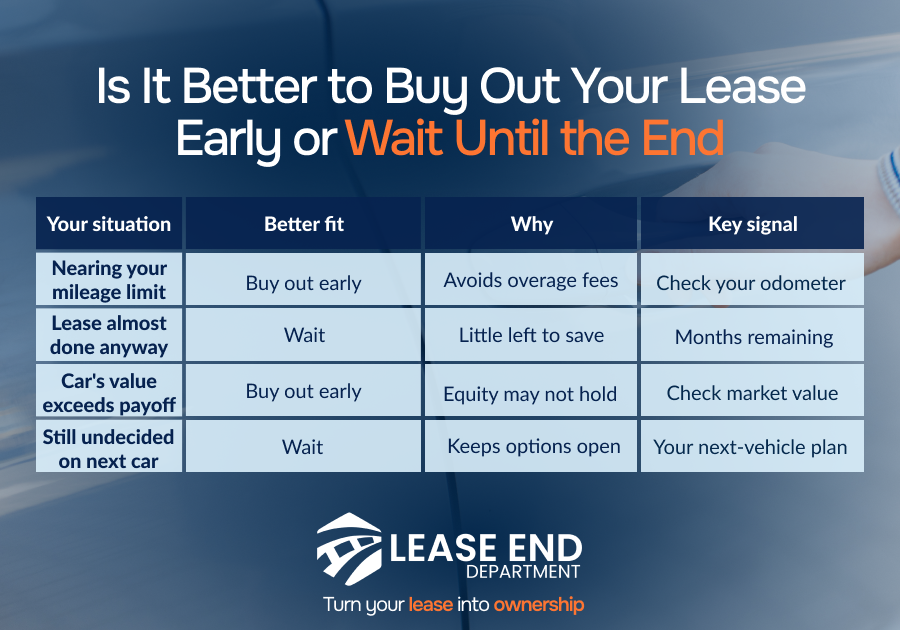
Timing Your Lease Buyout Comes Down to Your Numbers
There’s no version of this decision where “early” or “wait” is right for everyone. What settles it is the gap between what you’d owe and what your car is worth, whether that gap works in your favor today or is more likely to work in your favor months from now.
If you’re back in that driveway doing the math again, here’s the short version: an early buyout usually costs more than just the residual value, because you’re settling the remaining finance charges along with it.
Waiting keeps that number simpler, but it also means betting on where mileage, wear, and the used-vehicle market land by the time your lease is up. Neither bet is automatically the smart one. It depends on your car, your numbers, and how much certainty is worth to you.
Figuring out which side of that bet you’re on doesn’t have to be a guessing game. Lease End Department helps drivers:
- Request and review an accurate early buyout quote
- Compare it directly against your projected end-of-lease payoff
- Understand where you stand on mileage and equity before deciding
- Explore financing, whether you’re buying out now or waiting until the end
Whichever way the numbers point, the goal is the same: make the call based on what your lease costs, not on a general rule that was never built for your specific car.
Early Lease Buyout: FAQs
Can you buy out a car lease early?
Yes, in most cases. Most leasing companies allow an early buyout at any point during the term, though the exact payoff amount and any fees depend on your specific lease agreement and leasing company.
Should I buy out my lease early or wait until it ends?
It depends on whether your car’s current market value already exceeds your early payoff amount, or whether that gap is likely to widen in your favor by the time your lease naturally ends. There’s no single right timing. It comes down to comparing your specific numbers rather than following a general rule.
What’s the difference between an early lease buyout and an end-of-lease buyout?
An early buyout typically includes the residual value plus most of the remaining finance charges on your unpaid payments, while an end-of-lease buyout is generally just the residual value itself. That’s the core reason the two options aren’t simply “the same price, different date.”
Is it cheaper to buy out a lease early?
Not automatically. An early buyout can cost more than waiting because of the added finance charges, but it can also come out ahead if your car’s market value is strong right now and likely to soften before your lease ends. The only reliable way to know is comparing an actual early-buyout quote against your projected end-of-lease number.
Does mileage still count if I buy out my lease early?
Once you buy out the vehicle, whether early or at lease-end, you own it, so ongoing mileage restrictions and overage fees no longer apply. That’s one of the more common reasons drivers choose to buy out early: it locks in the car lease before mileage becomes a bigger issue.
Is there a penalty for buying out my lease early?
Not necessarily. A penalty typically applies to early termination, meaning you’re returning the vehicle before your term is up, more than to an early buyout, where you’re purchasing it. Some leasing companies waive or reduce those charges specifically when you buy rather than return, since they aren’t taking on the cost of reselling the car.
How do I know if I have equity in my lease?
Compare your vehicle’s current market value, which you can estimate using resources like Kelley Blue Book or Edmunds, against your early payoff quote from your leasing company. If the market value comes in higher, you likely have equity worth factoring into your decision.

