
Car Lease Buyout Loan Requirements: Key Takeaways
- Credit score matters, but it’s not the whole picture. Lenders also weigh your income, existing debt, and overall financial stability, so a lower score doesn’t automatically rule out approval
- The vehicle itself carries real weight in the decision. Because a lease buyout is financed much like a used-car purchase, lenders often compare your buyout price to the car’s current market value before approving a loan
- Car lease buyout loan requirements can look different from one lender to the next. Comparing your financing lease buyout options rather than accepting the first offer can affect both your approval odds and the terms you’re offered
- Gathering your payoff quote, income documents, and identification before you apply can help prevent delays and put your strongest application forward
If you’ve started researching a lease buyout loan, you’ve probably wondered whether your credit, income, or the car itself will be “good enough” to get approved.
Here’s some good news: getting approved doesn’t require a spotless financial profile.
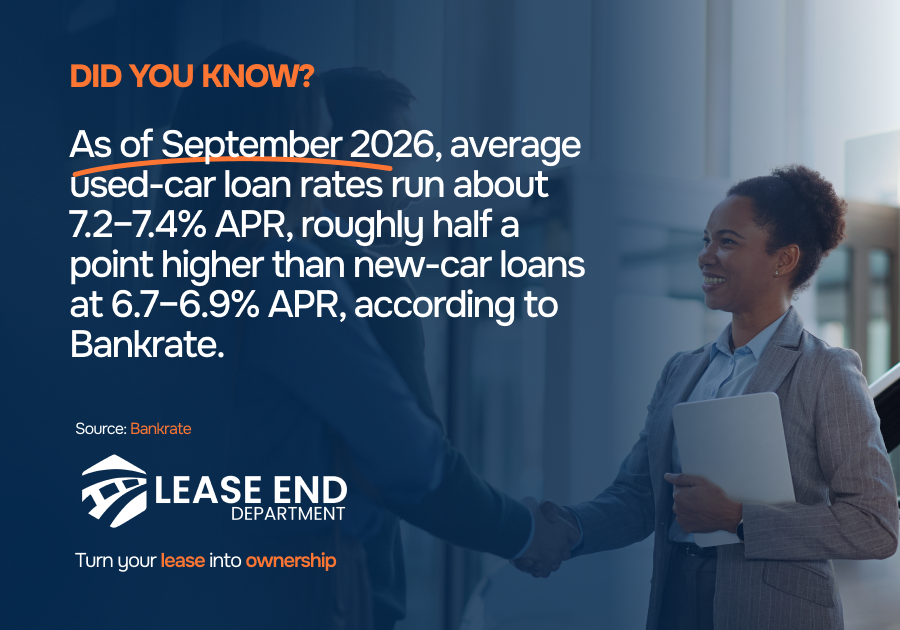
In fact, the average VantageScore® credit score for used-vehicle loan applicants was just 682 in early 2026, noticeably lower than the 751 average for new-car loans.
Since a lease buyout is financed like a used-car purchase (you’re buying a vehicle that’s already been on the road), that gap matters. Many drivers assume they need a far stronger credit file than lenders actually expect.
In this guide, we’ll walk through exactly what lenders look for when reviewing a lease buyout loan application, why requirements can vary from one lender to the next, and what you can do beforehand to put your strongest application forward.
Credit Score and Credit History
Your credit score is usually the first thing you think about before applying, and it’s an important piece of the puzzle. But it’s rarely the only thing a lender looks at, and it’s almost never a simple pass/fail cutoff.
What Counts as a “Good Enough” Score
There’s no universal minimum credit score for a lease buyout loan. Every lender sets its own thresholds, and those thresholds shift depending on the vehicle, the loan amount, and your overall financial picture.
As a loose reference point, lenders generally group scores into a few broad tiers:
- Excellent (750+): Typically qualifies for the most competitive rates
- Good (700–749): Usually approved with favorable terms
- Fair (620–699): Often approved, though rates may run higher
- Below 620: May still qualify with some lenders, especially with strong income or a down payment
These ranges are general guidelines, not guarantees. In fact, the average credit score for used-vehicle financing (the category most lease buyouts fall into) sits in the high 600s, well below what many drivers assume they need. A score below “excellent” doesn’t close the door. It just means it’s worth comparing more than one lender.
What Your Credit Report Shows Beyond the Number
Lenders don’t just pull your score. They review your full credit report to understand the story behind it, and they’re typically looking for patterns rather than a single isolated event.
That review commonly includes:
- Payment history: Whether you’ve consistently paid on time
- Current balances: How much of your available credit you’re currently using
- Length of credit history: How long your accounts have been open
- Recent inquiries: How many times you’ve applied for credit recently
- Derogatory marks: Any collections, repossessions, or bankruptcies on file
A single late payment from years ago is unlikely to sink an application on its own. A pattern of missed payments or a recent repossession carries more weight.
Income, Debt, and Vehicle Value: The Rest of the Approval Picture
Once a lender has a sense of your credit, two more questions come into play: can you comfortably afford the payment, and does the vehicle itself support the amount you’re borrowing? Both carry real weight, sometimes more than the credit score itself.
How Lenders Verify Your Income
Lenders want reasonable assurance you can manage the monthly payment before approving anything.
This is typically verified through:
- Recent pay stubs or W-2s
- Bank statements showing regular deposits
- Employment verification, especially for salaried applicants
- Tax returns or profit-and-loss statements for self-employed applicants
Consistency tends to matter as much as amount. A steady income history, even a modest one, is often viewed more favorably than a higher income with frequent job changes or irregular earnings.
Why Your Debt-to-Income Ratio Matters
Your debt-to-income (DTI) ratio compares your monthly debt payments to your gross monthly income. Lenders use it to gauge how much additional debt you can reasonably take on without becoming overextended.
Most lenders prefer a DTI below 45–50%, though acceptable thresholds vary by lender and can sometimes be offset by other factors, like a larger down payment.
If your DTI is running high, paying down a credit card balance or waiting until another loan clears before applying can meaningfully improve your odds.
Comparing Your Buyout Price to Market Value
A lease buyout loan differs from a typical auto loan in one important way: the vehicle isn’t new. Lenders compare your buyout price, generally tied to the residual value set in your original lease, against what similar vehicles are selling for today.
If your buyout price is at or below market value, lenders tend to view the loan as lower risk, since the car is worth what you’re borrowing against it (or more). If the buyout price runs notably higher than market value, some lenders may ask for a larger down payment, or decline financing altogether.
Understanding Loan-to-Value (LTV)
Loan-to-value (LTV) compares your loan amount to the vehicle’s appraised value, expressed as a percentage.
- A lower LTV generally works in your favor, since it gives the lender a cushion if the vehicle ever needed to be resold.
- A higher LTV, borrowing close to or above the car’s value, can mean a higher interest rate or an added down payment requirement.
Example: If your car appraises at $24,000 and you’re financing a $22,000 buyout, your LTV is roughly 92%, a ratio many lenders view favorably. If your buyout price is $26,000 against that same $24,000 valuation, your LTV climbs above 100%, which may prompt a lender to ask for money down to offset the added risk.
The car is collateral before it’s yours, its value carries as much weight as your credit file.
Between your income, your debt load, and the vehicle’s own numbers, a lender is really asking one question from a few different angles: can you afford this, and does the car back it up? Once you’ve got a handle on that, the last piece is making sure your paperwork is ready to go.
How Mileage and Condition Factor In
Mileage and condition affect resale value, so lenders often factor them into their decision too. Even when your buyout price is fixed by the lease agreement, the appraised value behind it can move based on things like:
- Mileage well above your lease’s annual allowance
- Exterior wear, such as dents, scratches, or paint damage
- Interior condition, including stains, tears, or odors
- Mechanical issues or needed repairs
- Tire and brake wear
None of these automatically sink an application, but a vehicle in rougher shape may appraise lower than expected, which can affect the loan-to-value math in the next section. If you’re not sure how prior damage or heavier-than-average mileage might factor in, our guide on what happens if you damage a leased car breaks down what typically counts against a vehicle’s value and what doesn’t.
Payoff Quote and Lease Buyout Documents
Once you know where you stand on credit, income, and vehicle value, the last piece is paperwork. It’s rarely the most exciting part of a lease buyout, but it’s often what determines how smoothly (and how quickly) your loan closes.
What’s Included in Your Payoff Quote
Your payoff quote, sometimes called a payoff letter, is the official amount required to purchase your leased vehicle. Lenders use this figure to determine exactly how much to finance, so it’s typically one of the first documents they’ll ask for.
A payoff quote generally includes:
- Your vehicle’s residual value
- Any remaining lease payments, if applicable
- The purchase option fee, if your lease includes one
- Sales tax, in some states
- Any additional administrative charges
One detail worth knowing before you apply: payoff quotes usually expire, often somewhere between 7 and 30 days depending on your leasing company. If yours has lapsed by the time you submit your application, request an updated quote first.
Documents Lenders Typically Request
Beyond the payoff quote itself, most lenders will ask for a handful of documents to verify your identity and your ability to repay the loan, including:
- A valid government-issued photo ID
- Recent pay stubs or proof of income
- Proof of residence, such as a utility bill or lease agreement
- Bank statements, in some cases
For the full checklist, including vehicle-specific documents like your registration, proof of insurance, and VIN, see our complete lease buyout documents guide.
How to Improve Your Chances of Approval
None of the factors above are fixed. There’s a real, practical set of steps you can take before you apply that can meaningfully change how a lender views your application, and how much the loan actually costs you.
Steps You Can Take Before Applying
Start with the things you can verify and control, rather than the things you can’t change overnight:
- Pull your credit report and check it for errors. A widely cited 2013 FTC study found that roughly 1 in 5 consumers had an error on at least one of their credit reports, and about 1 in 20 had an error significant enough to affect loan terms. Disputing a mistake before you apply, not after, is the only way it can help your application
- Pay down revolving balances if you can. Unlike your credit score, which can take weeks to reflect a change, your DTI ratio is calculated in real time from your current balances and income. Paying down even one credit card before applying can lower your DTI immediately
- Save toward a down payment. Every dollar you put down reduces both your loan amount and your loan-to-value ratio, which can work in your favor even if your credit or DTI isn’t perfect
- Request an updated payoff quote. Since payoff quotes expire, confirm you’re working with current numbers before a lender starts underwriting your application
- Time it deliberately. Starting the process 30 to 60 days before your lease ends gives you room to compare lenders and gather documents without racing an expiration date
Why Comparing Lenders Is Worth the Extra Step
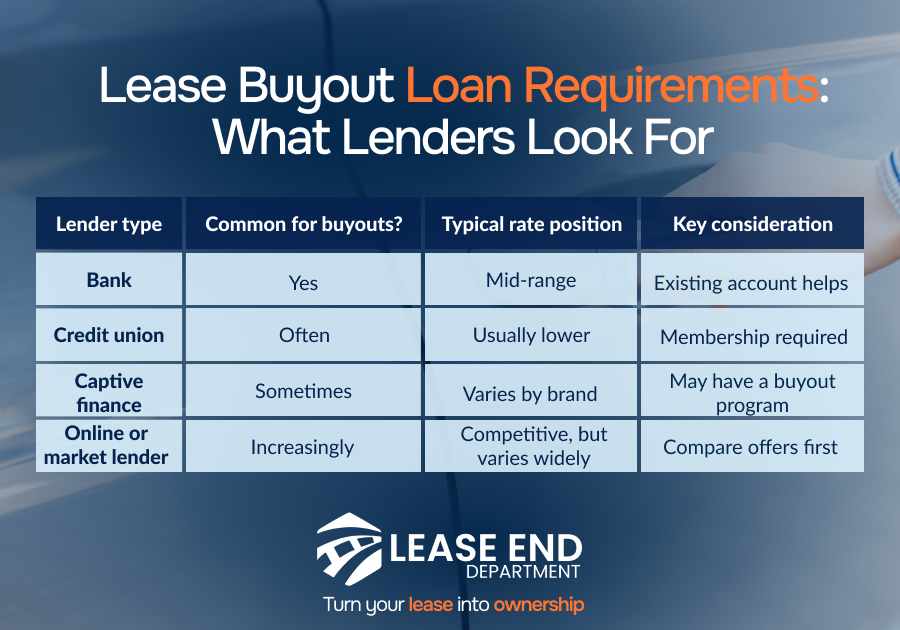
It’s tempting to accept the first offer you receive, especially if you’re worried about approval. But lease buyout requirements, and the rates lenders offer, can vary meaningfully from one institution to the next, so the first offer isn’t always the best one.
Here’s what a small rate difference costs over the life of a loan:
| Loan Example | 7% APR | 9% APR |
|---|---|---|
| Loan amount | $20,000 | $20,000 |
| Loan term | 60 months | 60 months |
| Monthly payment | ~$396 | ~$415 |
| Total interest paid | ~$3,780 | ~$4,915 |
Example estimates for illustration purposes only. Actual loan terms and payments vary based on lender requirements and borrower qualifications.
A 2-point difference in APR adds up to roughly $1,135 more over five years, more than most drivers save by negotiating the purchase price itself.
Car Lease Buyout Loan Requirements Don’t Have to Be a Mystery
There’s no single checklist every lender uses, and no universal score, income, or vehicle value that guarantees approval.
But that uncertainty cuts both ways: just as there’s no guaranteed “yes,” there’s also no automatic “no.” Credit, income, debt, and the vehicle itself all factor into the decision together, which means a weaker number in one area can often be balanced out by strength in another.
The drivers who move through this process with the least friction are usually the ones who prepare before they apply: checking their credit report for errors, gathering income and payoff documents ahead of time, and comparing more than one lender instead of accepting the first offer.
None of that guarantees approval, but it puts you in the strongest possible position to get it.
Navigating a lease buyout loan doesn’t have to mean guessing what a lender wants to see. Lease End Department helps drivers:
- Understand what lenders typically evaluate before applying
- Review payoff quotes and prepare the right documents
- Compare financing options from multiple lenders
- Move from application to approval with fewer surprises
Every driver’s financial picture is different, and the right lender, and the right terms, depend on your credit, your income, and the vehicle you’re financing. Knowing what to expect before you apply is the best way to make sure you’re not leaving a better rate, or a smoother process, on the table.
Car Lease Buyout Loan Requirements: FAQs
What are the requirements for a lease buyout loan?
The general car requirements for a lease buyout loan include a credit check, proof of income, a valid payoff quote, and information about the vehicle’s current value and condition. Exact requirements vary by lender, but most evaluate your credit history, debt-to-income ratio, and how your buyout price compares to the vehicle’s market value before approving financing.
How do I qualify for a lease buyout loan?
To qualify for a lease buyout loan, you’ll generally need a stable income, a manageable debt load, and a buyout price that’s reasonably in line with your vehicle’s current market value. Credit score matters, but it isn’t the only factor. Preparing your documents, checking your credit report for errors, and comparing multiple lenders beforehand can all improve your chances of approval.
What credit score do I need for a lease buyout loan?
There’s no universal minimum credit score required. Many lenders approve lease buyout loans for borrowers outside the “excellent” credit range, especially when income, debt-to-income ratio, and the vehicle’s value support the loan. A lower score may affect your interest rate more than your ability to get approved.
Do car lease buyout loan requirements vary by lender?
Yes. Car lease buyout loan requirements can differ significantly from one lender to the next, including acceptable credit ranges, income documentation, and loan-to-value guidelines. That’s one of the main reasons comparing multiple lenders, rather than accepting the first offer, is worth the extra time.
What documents do I need for a lease buyout loan?
Most lenders request your lease agreement, an official payoff quote, a valid government-issued ID, and proof of income. Some may also ask for proof of residence or bank statements. Our complete lease buyout documents guide covers the full checklist, including vehicle-specific paperwork like registration and insurance.
Does my vehicle’s value affect lease buyout loan approval?
Yes. Because a lease buyout is financed similarly to a used-car purchase, lenders typically compare your buyout price to the vehicle’s current market value. A buyout price at or below market value is generally viewed as lower risk, while a price well above market value may require a larger down payment or additional review.
Can I get a lease buyout loan with bad credit?
In many cases, yes. Lenders look at more than your credit score, including your income, debt, and the vehicle’s value, when reviewing a lease buyout loan application. If your credit needs extra attention, our guide on buying out a lease with bad credit covers this scenario in more depth.

