RAM Lease Buyout: Key Takeaways
- For most RAM owners, this is a practical decision first. If the truck still fits your needs, keeping it can make sense
- Truck prices remain strong. Replacing a similarly equipped RAM may cost more than expected today
- Mileage and wear matter. Buying out the lease can help avoid expensive return charges
- Look beyond the payoff number. Taxes, financing, and ownership costs all shape the real decision
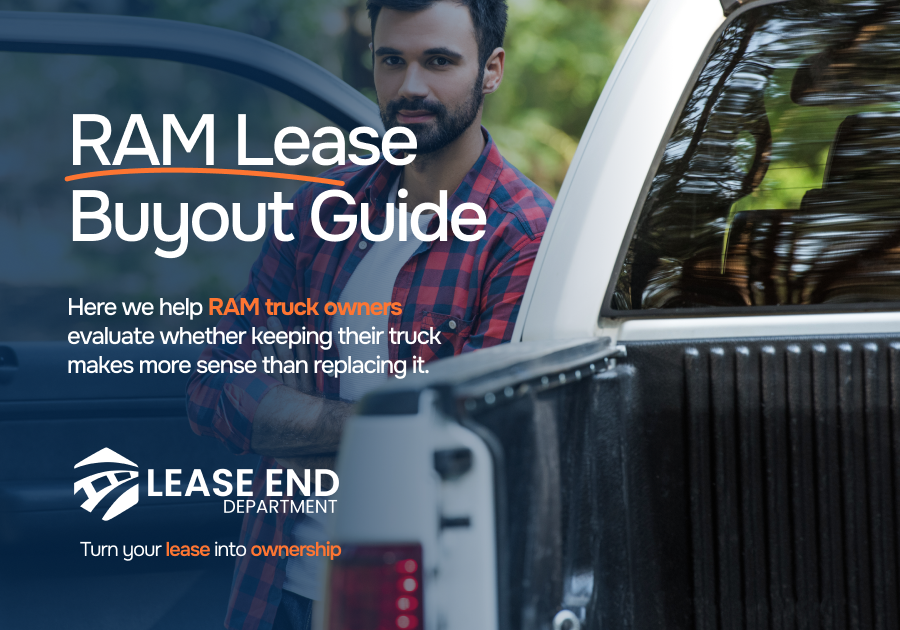
Most RAM owners use their trucks for specific daily needs, whether that’s towing, hauling, work use, long commutes, or simply having a vehicle that can handle more demanding driving conditions.
That’s what makes this decision different.
You’re not just asking, “What’s my next car?” You’re asking, “Do I keep the truck that already works for me?”
And right now, that question matters more than ever. Truck prices have remained strong in recent years, and replacing a RAM with a truck that offers the same capabilities and features may cost more than expected.
So before you make a move, it’s worth stepping back and looking at the full picture.
In this guide, we’ll cover:
- How a RAM lease buyout works in real terms
- What costs, fees, and ownership factors to expect
- How usage and condition affect your decision
- Financing options and what to watch for
- When keeping your truck makes sense, and when it doesn’t
Why RAM Lease-End Decisions Are More Practical Than Financial
For many RAM drivers, the decision comes down to whether the truck still fits their work, routine, or daily driving needs.
It’s about whether the truck still does what you need it to do.
That changes the way people think about buyouts.
Your Truck Has Already Proven Itself
By lease-end, many RAM owners already have a good sense of whether the truck still works for their needs.
You know:
- How it handles towing or hauling
- How it performs in bad weather
- Whether it holds up to your daily workload
For drivers who rely on their truck consistently, replacing it often involves more uncertainty than simply keeping the current one.
Replacing a Comparable Truck Can Be Expensive
One thing many RAM owners realize late in the process is how expensive it can be to replace their current truck with a similar one.
Feature packages, towing capability, upgraded trims, and aftermarket additions all add up quickly in today’s market. What felt affordable when the lease started may look very different now.
That’s why some drivers stop comparing “buyout vs return” and start comparing:
“Keep this truck” vs. “pay significantly more for another one.”
How Do You Decide Whether to Buy Out Your RAM?
The buyout process itself is simple.
The bigger question is whether replacing the truck would realistically improve your situation enough to justify the additional cost.
In many cases, owners are comparing a truck they already trust against the cost and uncertainty of starting over with another one.
Start With the Payoff Number, but Don’t Stop There
The first step is getting your official payoff quote from Chrysler Capital.
This includes:
- Your residual value
- Any remaining lease obligations
- Applicable fees or purchase costs
That gives you the baseline. But with trucks, the payoff cost alone rarely tells the full story.
Practical Value Matters Too
Most drivers immediately check pricing tools or dealer offers.
That matters, but with a RAM, there’s another question that’s often more important:
How valuable is this truck to you based on how you use it?
A truck that’s already set up for your needs, whether that means towing equipment, bed liners, upgraded tires, or daily work use, can carry practical value that pricing tools won’t fully capture.
What Would It Cost to Replace This Truck Today?
This is where many RAM owners pause.
Replacing your RAM with a similarly equipped truck may cost more than expected, especially if:
- You have a higher trim package
- Truck prices in your area remain strong
- You’ve added accessories or upgrades
For some drivers, the comparison shifts from:
“Should I buy this truck?” to: “Do I really want to start over with another one?”
The Decision Usually Becomes Clear Here
Once you compare your payoff, your truck’s condition, and today’s replacement cost, the direction often becomes easier to see.
If the truck still works well for your life and the numbers are reasonable, a buyout can make practical sense. If not, returning it and moving on may be the cleaner option.
After that, the final steps, financing, title transfer, and registration, are relatively straightforward.
What It Actually Costs to Keep Your RAM
The buyout price on your lease agreement is only the starting point.
With trucks, ownership costs tend to become more noticeable over time because the vehicle is often used harder and driven more consistently than a standard commuter car.
That’s why it’s important to look at both the upfront cost and what owning the truck will realistically cost you after the lease ends.
The Upfront Costs Are Fairly Straightforward
When buying out your RAM lease, the initial costs usually include:
- The residual value listed in your lease agreement
- Sales tax, which varies by state
- Title and registration fees
- A possible purchase option fee through Chrysler Capital
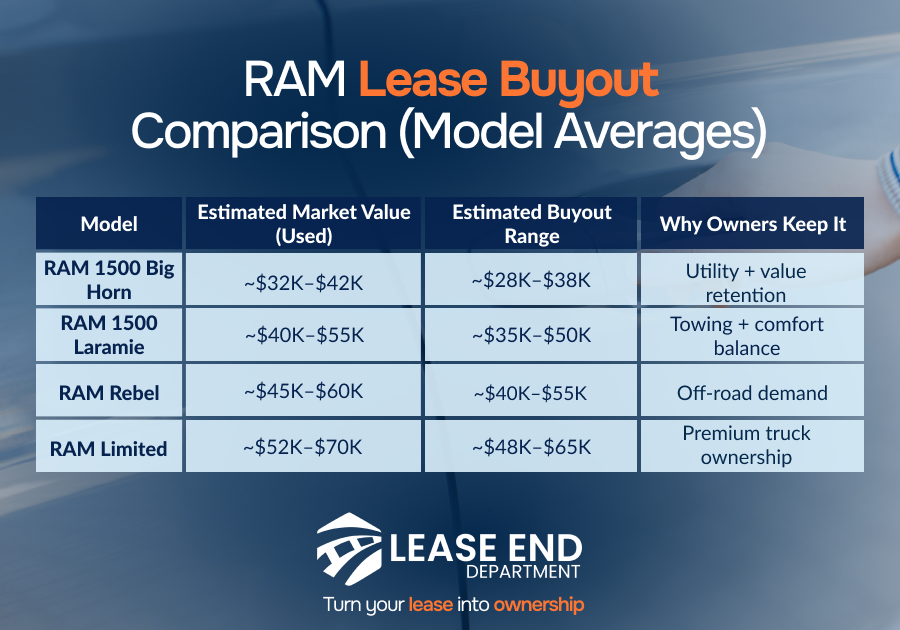
For many RAM 1500 leases, the numbers often look something like this:
- Residual value: approximately $28,000–$38,000
- Taxes and fees: roughly $2,000–$4,000 depending on location
That means the actual amount needed to complete the buyout is usually higher than drivers expect at first glance.
Ownership Costs Start to Matter More After the Lease
This is where truck ownership becomes different from leasing.
Once the vehicle is yours, you begin absorbing the long-term costs that leasing helped smooth out.
For RAM owners, that commonly includes:
- Brake and tire replacement, especially for towing or heavy use
- Suspension wear depending on road conditions and payload
- Fuel costs, which can vary significantly based on driving habits and engine choice
- Insurance costs, particularly for higher trims or newer trucks
These costs don’t automatically make a buyout a bad idea. They just become part of the real ownership equation.
Why This Matters More With Trucks
A RAM that’s used for work, hauling, or regular long-distance driving accumulates wear differently than many passenger vehicles.
That’s why some truck owners actually prefer buying out the lease. They already know how the truck has been treated, maintained, and driven, which removes some of the uncertainty that comes with replacing it.
Should You Keep Your RAM or Move On?
This is usually the point where the decision becomes real.
Not because of the paperwork, but because you start weighing a truck you already know against the idea of replacing it with something newer (and probably more expensive).
For many RAM owners, that trade-off is more practical than emotional.
Where Drivers Often Get It Wrong
One of the biggest mistakes truck owners make at lease-end is underestimating how expensive returning the vehicle can become.
A truck that’s been used the way trucks are supposed to be used (towing, hauling, job sites, long miles) can accumulate wear that matters during inspection. For owners who tow regularly or drive long distances, knowing exactly how the truck has been maintained can carry a lot more value than starting over with another used vehicle.
Another common issue is overlooking how useful the truck has already proven itself to be.
If your RAM already fits your work, your lifestyle, or your daily routine, replacing it isn’t always as simple as getting another vehicle. It often means:
- Higher truck prices
- Different financing terms
- Starting over with a vehicle you don’t know yet
Some drivers also rush into a decision without checking what comparable RAM trucks are selling for in today’s market, which can lead to overpaying or walking away from a solid buyout opportunity.
Buyout vs Upgrade: What Are You Really Choosing?
At first glance, the choice seems simple.
Buy the truck or upgrade to a newer one.
But in reality, you’re deciding between two very different paths.
A buyout means keeping a truck that’s already proven itself. You know how it drives, how it’s been maintained, and what it’s capable of.
An upgrade gives you newer technology, a fresh warranty, and the ability to reset mileage and wear. But it also usually comes with higher pricing and starting the process over again.
Neither option is automatically better.
Make the Right Decision for the Truck You Already Know
By the end of a RAM lease, most drivers already have their answer, at least partially.
You know how the truck performs. You know what it’s been through. And you know whether it still fits the way you work, drive, or live day to day.
In most cases, the decision comes down to cost, usage, and whether replacing the truck would actually improve anything meaningful.
For some owners, buying out the lease makes perfect sense. The truck still has value, replacement costs are high, and starting over doesn’t feel necessary. For others, lease-end is the right time to move into something newer with updated technology, warranty coverage, or different capabilities.
The important part is understanding the full picture before making a move.
That’s where Lease End Department can help.
Instead of rushing through the process or relying only on dealership guidance, you can compare your options clearly, understand your true buyout cost, and decide what makes the most sense for how you use your truck.
Why RAM owners choose Lease End Department:
- Clear breakdown of buyout costs: Taxes, fees, and financing included
- Compare keep vs replace options: Side-by-side, without pressure
- Access competitive financing options: Not just dealership offers
- Support through the paperwork process: From payoff to title transfer
- Guidance built around real truck ownership: Not generic lease advice
At the end of the day, this decision isn’t just about ending a lease.
It’s about deciding whether the truck that’s already proven itself continues to deserve its place in your driveway.
Besides RAM, we also specialize in lease buyouts for additional popular brands, including:
- Toyota Lease Buyout
- Honda Lease Buyout
- Hyundai Lease Buyout
- Kia Lease Buyout
- Acura Lease Buyout
- Mercedes-Benz Lease Buyout
- Chrysler Lease Buyout
- Mazda Lease Buyout
- Nissan Lease Buyout
RAM Lease Buyout: FAQs
Can you buy out a RAM lease early?
Yes, you can buy out a RAM lease before the lease term ends. However, the payoff may include remaining lease payments and additional fees, which can increase the total cost.
How is a RAM lease payoff calculated?
A RAM lease payoff usually includes the residual value, any remaining payments, and applicable purchase fees outlined in your car lease agreement.
Do you pay sales tax on a RAM lease buyout?
In most states, yes. A RAM lease buyout is treated as a vehicle purchase, so sales or use tax applies based on your state and local tax rates.
Is buying out a RAM 1500 lease worth it?
It can be worth it if the truck is in good condition, fits your needs, and the buyout price compares favorably to current truck market prices.
Can you finance a RAM lease buyout?
Yes. You can finance a RAM lease buyout through Chrysler Capital, banks, credit unions, or online lenders, depending on your credit profile and preferences.
What fees are involved in a RAM lease buyout?
Common costs include sales tax, title and registration fees, and a purchase option fee, along with financing costs if you take out a loan.
Can you negotiate a RAM lease buyout price?
Usually, no. The residual value is set in your original lease contract. However, you can still reduce overall costs by comparing financing options and understanding all fees involved.
Does mileage matter when buying out a RAM lease?
Yes, but differently than with a return. High mileage may reduce market value, but if you buy the truck, you avoid mileage overage penalties that normally apply when returning a lease.
Should I buy my RAM lease or lease a new truck?
It depends on your situation. Buying may make sense if your current truck still meets your needs and replacement costs are high. Leasing a new truck may be better if you want updated technology, warranty coverage, or different capabilities.